
Sometimes it feels like communications and PR industry reports never stop arriving in our inboxes. They get skimmed, the stats are noted or updated in a slide deck, and then we move on to the next.
It’s not that communications professionals aren’t interested. It’s just that so often the data confirms what we already instinctively sense through practice. The latest Reuters Institute Digital News Report did reveal something genuinely interesting though: for the first time, social media and video platforms are the most widely used way of accessing news globally (54%) overtaking news websites and apps (51%).
Depending on how you look at it, this is either big news or old news. The inevitable continuation of this long-running trend isn’t a shock, but it is a huge milestone, even if it doesn’t feel especially disruptive.
The UK Government is explicitly responding to the changes in where and how news is consumed, with the UK Government’s Media Green Paper setting out proposals to make it easier for trusted news sources to be discovered on social media. A consultation runs until the end of August on how to make news content from the BBC, ITV, Channel 4 and others easier to find, such as making sure national and local publishers are more likely to show up at the top of people’s social feeds.
The thing is, we’ve been here before. The printing press changed who could publish and access information. Twenty-four-hour rolling news changed how immediately we expected it. Then the internet changed how quickly and how far it could travel. Social media has been “the thing that changes everything” for well over a decade.

In reality, this latest stage is more cumulative than revolutionary. Thinking about McLuhan’s idea that the medium is the message, it’s never been more true that the medium doesn’t just shape what we see, it shapes whether we see it at all. And then it shapes whether we believe it.
Trust is down, but concentrating in familiar brands rather than disappearing
Trust in news is still declining. In the UK, it sits at about 30%, less than a third of people. Only a small minority of people, around 10%, pay for news at all.
None of these figures are suprising in isolation, but they do matter as proof of what these gradual changes are doing to the wider systems they impact. Less willingness to pay for news puts pressure on publishing companies and their ability to staff newsrooms. Reduced capacity affects the speed and quality of news outputs, this then dings trust again. It’s familiar territory but it never hurts to revisit how each little cog is affecting the overall performance of the media machine.
Maybe that’s why existing trust is concentrated so heavily on familiar news brands. BBC News is still the most trusted, (59%) followed by Channel 4 (57%) and ITV News (57%). The trust people place in individual news brands has barely changed at all.
So, communications teams shouldn’t be spooked by declining trust. Validation from earned media is still hugely valuable, possibly even more so as trust in wider systems breaks down. But we need to think more carefully than ever about where the validation is coming from. Quality over quantity has always been what we aim for, but if the government’s plan to make Public Service Media more prominent on social platforms goes ahead, that pool of “safe” brands will matter even more.
AI isn’t replacing news consumption yet, but it’s adding a layer to information sharing
Globally, around one in ten people are now using LLMs to access news, up from 7% in the previous year.
It isn’t evenly spread; AI platform use for news is more concentrated among younger people (16% of under 35s) and people already interested in news. This suggests it’s an engaged audience segment rather than a casual one.
Around 42% of LLM users also said the most valued feature is the ability to ask follow-up questions, which highlights another shift: active exploration of information rather than passively receiving and sharing it. Whether audiences are intentionally “getting news” from AI or not, they are still being fed summaries, interpretations, and narratives generated by them.
For any message to survive being chewed up and spat back out by the bots, substance needs to win over style. These systems are mediating what our human audiences see, and nuance might not make it to the final product, so communicators need to push for clarity and context over cleverness.
So what does any of this mean for B2B communications?
Beyond the obvious sense that the times are (still) changing? Validation from coverage still matters, but the system is messier than ever. The pool of sources able to provide that validation is simultaneously wider and narrower than it’s ever been: spread all over social media, filtered through the bots, and concentrated in an increasingly small number of “safe” news brands. We need to make sure that the message lives on beyond that initial hit of coverage.
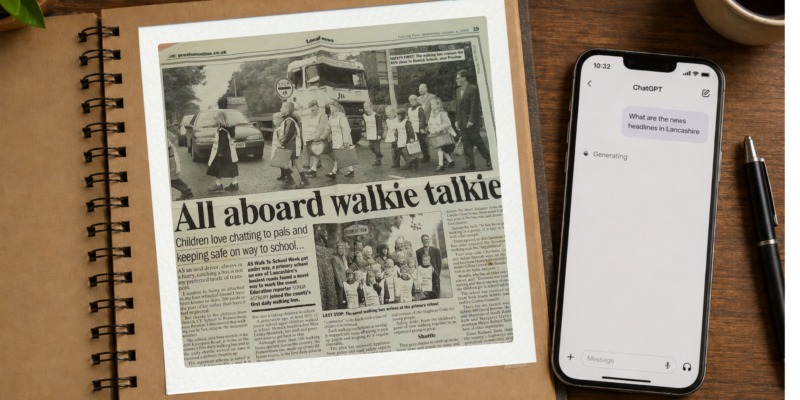
Now, if you’re reading this and thinking “I knew all this already” well, exactly. Nothing ends at coverage now, but it never has. Just ask my mum, who will get out clippings of my primary school exploits with little to no encouragement, decades later.
What it all comes down to is thinking less about getting a story to land and more about the persistence of messaging. It’s not a new challenge; we’ve known for years to think beyond whether a story is picked up by media and to factor in social media engagement. Communications teams have always had to survive their messages being paraphrased or taken out of context. What’s changed is who is doing the reshaping. As well as briefing journalists, we’re also briefing algorithms and AI. It just needs a different kind of fluency to make sure the story still means the same thing down the line.