

Open an online news article today and there’s a good chance you’ll see more than just a wall of text.
A vertical video of the reporter might autoplay near the headline. A chart will animate as you scroll. There may be an interactive map, a timeline, or a “watch this in 60 seconds” clip among the prose.
That’s not accidental, and it isn’t confined to the big international titles. Many media outlets are actively becoming richer, more visual, and more interactive; that shift has created a real opportunity for brands that think multimedia-first in their media outreach.
Putting the trend in context
A recent study tracking news publisher web pages has found that interactive elements on media websites have grown by roughly 68% since the launch of ChatGPT, while underlying article volume on those same sites fell by about 31%.
In short, publishers are producing fewer pages, but making each one work harder.
The Reuters Institute’s Trends and Predictions 2025, which surveyed 326 digital leaders across 51 countries, captured the same shift – video investment by media outlets is up significantly, and much of that effort is being pulled back onto publishers’ own sites.
What this looks like in practice
The format that’s drawn most attention is what The Atlantic’s Charlie Warzel has called “prestige TikToks”, vertical videos of journalists talking to camera, embedded into articles.
The Daily Mail has gone further on this than almost any other UK title. Around 50 people now work in video at MailOnline, split between a social team producing vertical content for TikTok (where the Mail has 26m+ followers across 12-plus accounts) and a “site team” of around 30 making video to accompany the publication’s text reporting.
In the States, The Washington Post produces about half its daily video output in vertical format, with the New York Times also pushing into reporter-fronted vertical formats.
The Guardian, meanwhile, is really embracing multimedia in all its forms. It’s built one of the UK’s most respected visual journalism operations, with a long-running Datablog and award-winning interactive features that weave video, graphics and text into single immersive stories.
It isn’t just national titles
It’s not just big nationals. The same shift is well underway in financial/business and B2B/trade media. Citywire runs a substantial audio-visual operation with video-based analysis sitting alongside much of its written coverage. Bloomberg’s 30-strong data journalism team produces roughly 100 quick charts and 35 deeper standalone interactive graphics every month. Its TikTok channel has amassed over 18.9m likes and features a range of both interviews and news story overviews.

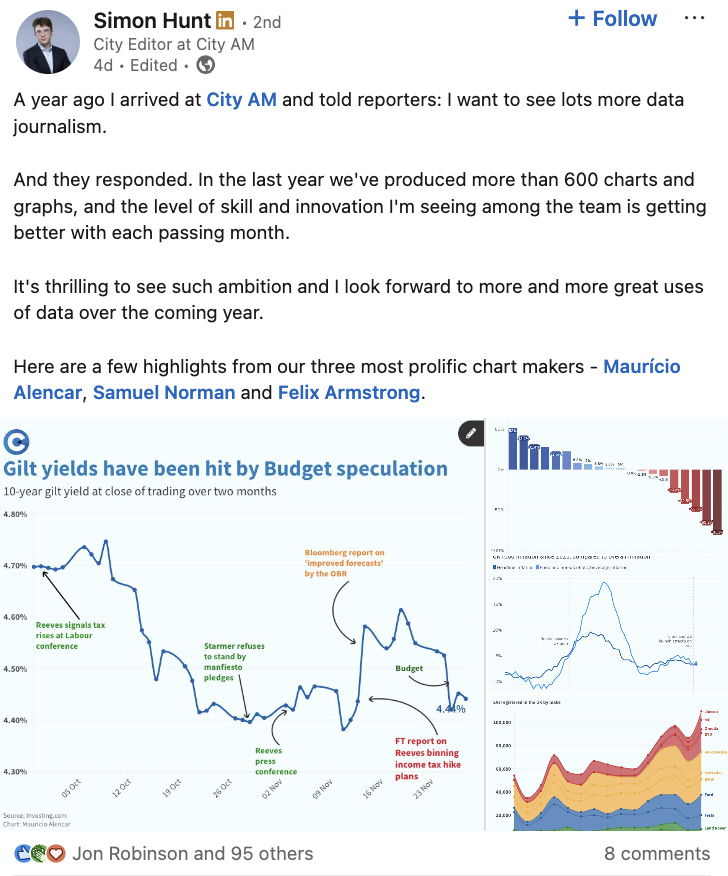
City AM is actively following suit in prioritising the visualisation of data, as this recent LinkedIn post from its City Editor demonstrates:
Trade media is moving on a similar trajectory. For example, Retail Week recently launched its AI Investment Tracker and also features a regular Charts of the Week feature that turns data into the lead format rather than an illustration alongside text. In logistics, The Loadstar hired its first dedicated multimedia content creator in late 2025, specifically to lead “cutting-edge video projects” including short docu-style series and 360-video as part of its core editorial output.
Why it’s happening
Several pressures are working together to drive this focus on multimedia pages by news outlets.
Firstly, audiences now expect video. 66% of respondents globally watch short news videos every week, but more than two-thirds of that viewing happens on platforms, not publisher sites. So, there’s significant pressure on outlets to find ways to get that traffic onto their websites directly.
At the same time, search referral traffic is collapsing, with around three-quarters of digital leaders worried about declining Google traffic. As a consequence, outlets are looking for more routes to capture and maintain audiences that doesn’t rely on traditional search.
With TikTok becoming the most popular form of search for Gen Z and YouTube being the second most visited website in the world, it makes sense for outlets to integrate better into their ecosystems as a new way to encourage discovery.
Adding to that, there’s a growing belief that multimedia-rich pages perform better in AI-generated answers. The result is media outlets increasingly prioritising fewer, but richer, pages that can be found in more ways and which encourage readers to stay on site.
The opportunity for B2B brands
These goals create new resource requirements, which can be difficult to meet for media outlets already under financial strain. The result is an increasing gap between what publishers want to produce and what they can achieve in-house. That’s especially true at trade titles, where graphics and video teams are leaner than at the consumer giants.
This creates new opportunities for brands to support media contacts and be featured more prominently with the news and insights they create. For example, a press release with strong original data, a clean chart and high-quality imagery helps a journalist act on a number of formats they may be thinking about for a new story. A pitch that might have warranted three paragraphs as text-only can become a richer piece with a short video clip of a CEO sharing their perspective.
With that in mind, here are five things to consider when looking at developing rich packages for multimedia-hungry outlets:
Lead with original data: Charts work best when the underlying numbers aren’t available anywhere else – proprietary surveys, transaction data, internal benchmarks.
Hit the visual quality bar: A chart branded so heavily it looks like an ad won’t get used. Something that looks like it’s been quickly pulled together and turned into a chart in Excel is also less likely to make the grade. The key is to minimise the work for media contacts. Aim for something that could have come from a graphics desk, including clean typography and clear sourcing, and ideally in a format that can be tweaked further to meet house style.
Make video usable, not promotional: Similarly with video, go easy on the branding – a two-minute corporate sizzle reel won’t get embedded. A 30-second clip of a spokesperson explaining one specific finding to camera, in a format publishers already produce in-house, will. Bear in mind the formats used by the outlets you’re targeting; vertical is crucial for sharing with outlets leaning into prestige TikTok, but others are still favouring landscape, TV style formats.
Get your experts on board: Doing this well means encouraging your brand experts to support PR efforts in new ways. Where once they might have provided written quotes for news releases and saved video for big, well-rehearsed launches, video content is increasingly part of day-to-day media work. Their voice on camera may be needed more often, in quicker and more off-the-cuff ways. Brief and prepare spokespeople for shorter, less scripted video formats, and build that into your media training as standard, not just for crisis or major launch moments.
Lastly, optimise for AI too: Think about what outlets will be thinking about for optimisation. Releases should be written with structured data and schema markup in mind, for example. Expert quotes with clear attribution appear to get picked up more readily by LLMs. Consider offering helpful alt text suggestions for images you share.
You can’t control AI optimisation for content you’re giving to someone else as much as you can something you’re putting on your own site. But you can help make life easy for media outlets who will be focused on their own AI optimisation.
The shift towards multimedia-led storytelling is a real opportunity for B2B brands who understand what their target outlets need and can deliver content that adds genuine value.
If you’d like support creating richer content to make the most of this opportunity, get in touch.